Snow Blowing vs. Plowing for Sloped and Curved Driveways
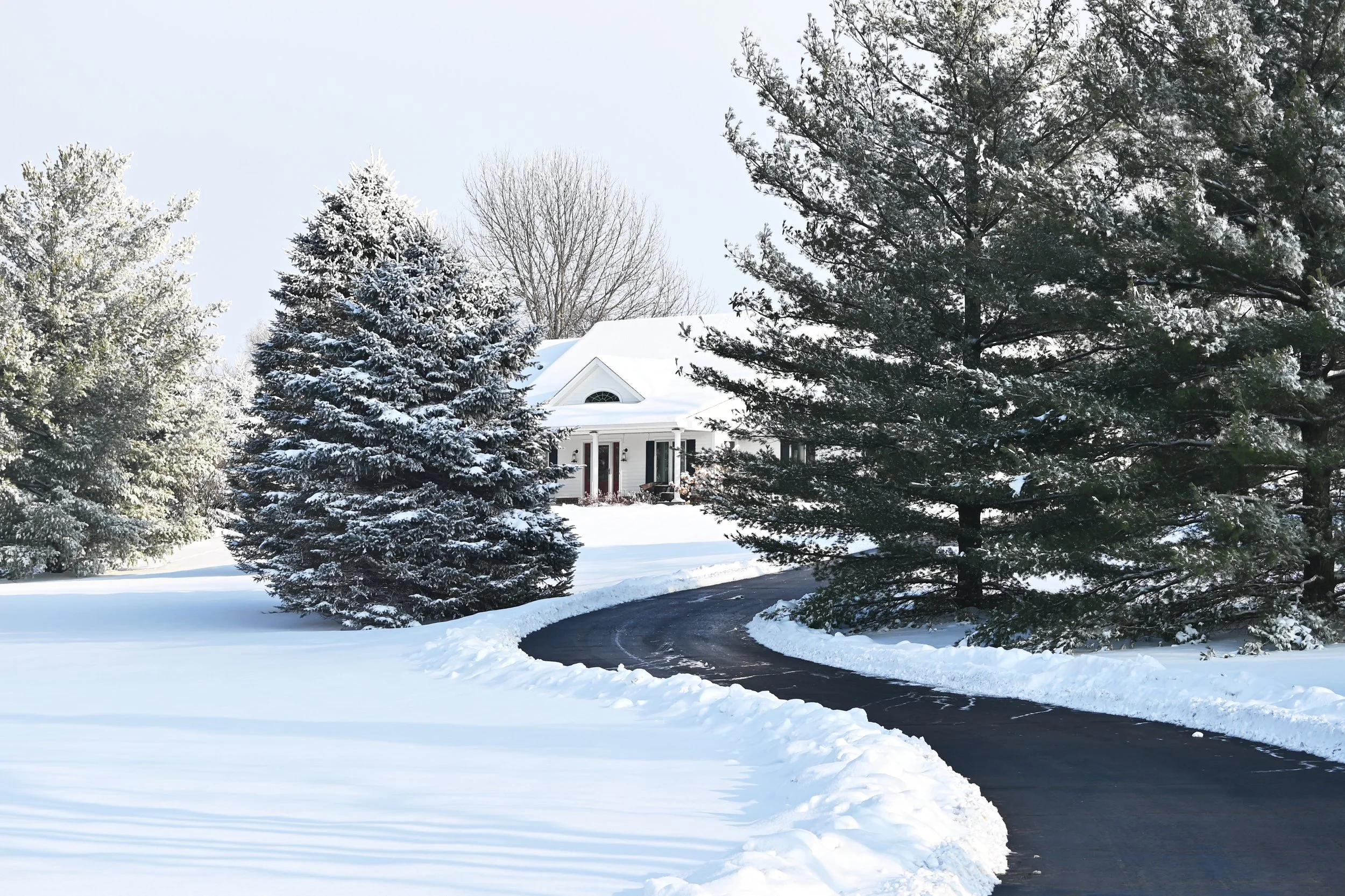
Not all driveways are created equal. Slopes, curves, and angled approaches may look subtle in summer, but winter exposes how difficult they are to clear safely. Traditional plowing works well on wide, flat surfaces. Once elevation changes or curves enter the picture, its limitations become clear.
Snow blowing offers a more controlled approach — one that handles complex driveway shapes with precision rather than force.
Why Plows Struggle on Slopes and Curves
Plows are designed to push snow forward in a straight line. On a sloped driveway, that snow naturally wants to move downhill. As it piles up, meltwater runs back across the surface and refreezes, creating slick conditions that are difficult to manage.
Curved driveways present a different problem. A rigid blade can’t maintain even contact through turns, which leads to:
Uneven clearing
Packed snow left behind
Scraping at high points
Ice forming in low spots
These issues compound with each storm, increasing both safety risks and surface wear.
Snow Blowing Maintains Control on Inclines
Snow blowers lift snow vertically and throw it away from the driveway in controlled directions. That matters on slopes. Instead of pushing snow downhill and fighting gravity, snow blowing removes it completely, reducing the chance of refreeze and slide-back.
For homeowners in Fairport NY, where sloped driveways and multi-car approaches are common, this results in:
More consistent traction
Less ice buildup near garages
Fewer mid-winter re-clears
Precision Clearing Through Curves and Transitions
Curves, aprons, and garage transitions are where plows lose effectiveness. Snow blowers maneuver easily through these areas, maintaining even coverage without scraping or skipping.
That precision matters most in:
Curved residential driveways
Driveways with raised borders
Angled garage entrances
Narrow transitions to walkways
Snow blowing leaves a flatter, more predictable surface — one that’s easier to walk and drive on throughout the winter.
Fewer Ruts, Less Surface Stress
Repeated plowing on sloped or curved surfaces often leads to ruts and compacted snow paths. Those ruts freeze solid, making them difficult to remove later and increasing wear on the driveway itself.
Snow blowing prevents this buildup by removing snow fully with each visit, keeping the surface closer to its original grade.
A Better Fit for Non-Standard Driveways
In neighborhoods throughout Webster NY, many homes feature driveways that were designed for appearance rather than plow efficiency. Snow blowing respects those designs instead of working against them.
For driveways with elevation changes or curves, snow blowing isn’t just an alternative. It’s the method that matches the layout.