When winter arrives in Upstate New York, the primary goal for any homeowner is simple: get the snow off the driveway so daily life can continue.
Because the end result looks the same on the surface, it is easy to assume that all snow removal methods are created equal.
However, if you look at the mechanics behind how snow is actually moved, the physics tell a completely different story.
The two primary methods of residential snow removal—traditional truck plowing and tractor-mounted snow blowing—approach the problem from entirely different engineering perspectives. One relies on downward scraping force, while the other utilizes mechanical displacement.
Understanding these differences explains why one method naturally protects your property while the other poses an inherent risk.
The Physics of Plowing: Mass and Friction
A traditional plow truck operates on a simple principle: brute force. To clear a driveway, a truck must use its physical mass and tire traction to push a heavy, steel-edged blade forward, shoving a wall of snow ahead of it.
This creates a few mechanical challenges for your driveway surface:
Down-Pressure Scraping: To get close to the pavement, the plow blade relies on intense downward pressure. When metal edges scrape repeatedly against asphalt, stamped concrete, or stone pavers, the friction causes micro-abrasions, surface pitting, and structural wear over time.
The Momentum Problem: When a plow truck hits a heavy drift or a frozen city plow wall, it requires a burst of momentum to break through. That sudden impact transfers directly down through the blade into your driveway's sub-base, which can accelerate shifting and cracking.
Accumulated Weight: As the blade fills with snow, the truck is pushing thousands of pounds of dead weight. This weight is compressed against the pavement, often packing down a thin layer of tire-track ice that requires heavy chemical salting to melt later.
The Physics of Blowing: Velocity and Flow
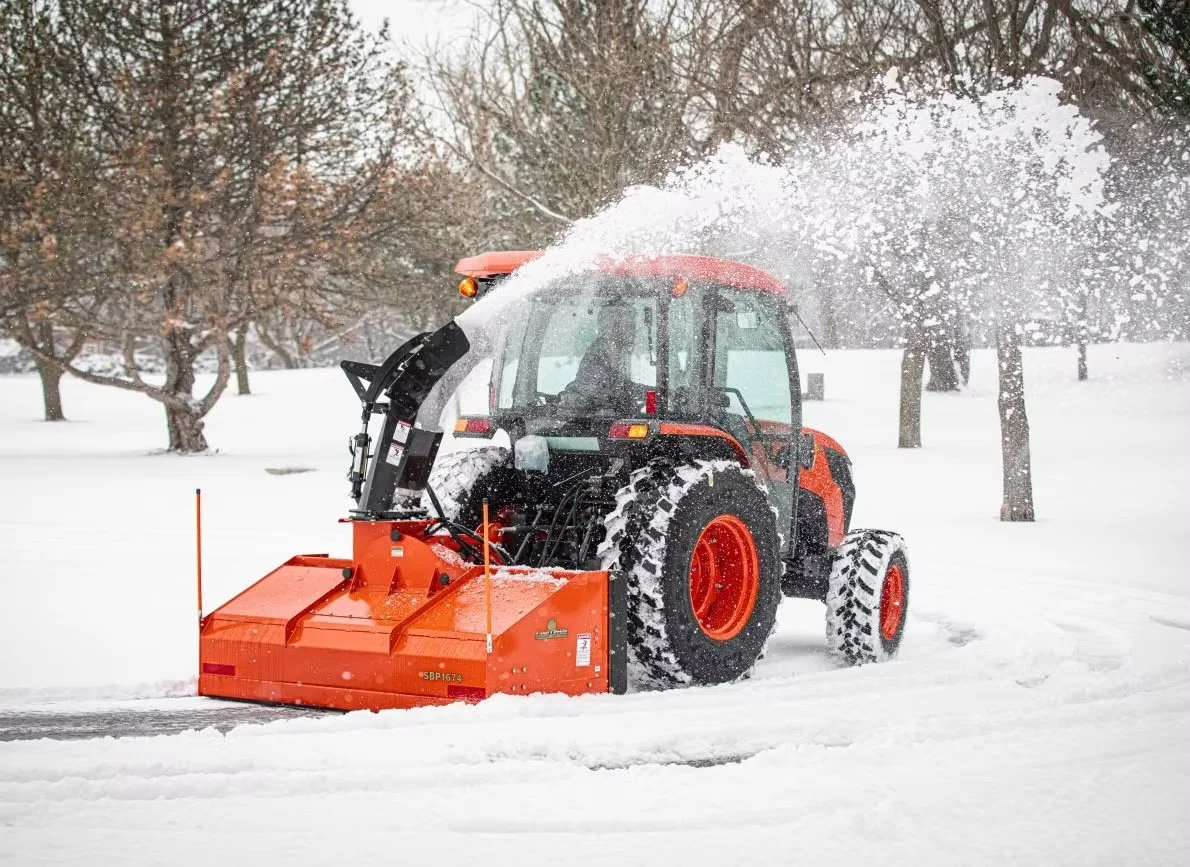
Tractor-mounted snow blowers completely eliminate the need for friction-based pushing. Instead of shoving the weight of the snowbank across your property, a blower processes the snow right where it sits.
Rotational Augers: As the tractor moves forward, a high-speed steel auger chews through the snow, breaking up chunks of ice and heavy slush instantly. The snow is fed directly into an impeller fan that uses centrifugal force to launch it cleanly through a chute.
Poly-Edged Protection: Because the machine isn't trying to scrape ice by brute force, the blower head doesn't need a harsh metal edge. It rides on specialized poly-edged skids that glide a fraction of an inch above the actual driveway surface, providing clean results without the metal-on-stone contact.
Even Distribution: Rather than piling massive, heavy banks at the edges of your drive—which can trap moisture and cause the ground underneath to buckle during freeze-thaw cycles—a blower disperses the snow into a fine mist evenly across your yard.
Investing in the Right Mechanics
When you look at the mechanical reality of both systems, it becomes clear that snow blowing isn't just an alternative method; it’s an entirely different level of property maintenance.
By replacing heavy pushing and scraping with efficient mechanical displacement, you protect the structural integrity of your driveway and eliminate the hidden costs of spring repairs.